
Oak leaves, fallen and still hanging on, are announcing that November is here, and with it the right time to plant fruit trees. If you’re planning to plant a new tree in your own (or someone else’s) garden this year, this article, packed with deeply technical terminology, is just for you.
A “dwarf” is not a small tree
First I’d like to explain a commonly used but still slightly mysterious term: zákrsek. That’s what Czech nurseries call one of the training forms of a fruit tree, and it literally means “dwarf” (English nurseries would call it a bush tree). In my view it’s a rather unfortunate name. It practically invites you to imagine that the tree will stay tiny and is therefore the right choice where space is tight.
What really determines a tree’s final size and height is, above all, the rootstock.
Let me use my favourite (childish) old joke: a tree consists of four parts, and these three are – the rootstock and the variety.
Any tree you buy is made of two genetically different parts. The upper one, the variety, determines things like what the fruit will look like. An apple can be green, yellow or red, smell like pineapple or have red flesh. The lower one, the rootstock, forms the roots and decides mainly how the tree will grow.
We’ll get to rootstocks in a moment. First, let’s explain the training forms I mentioned.
The training form tells you where the crown starts
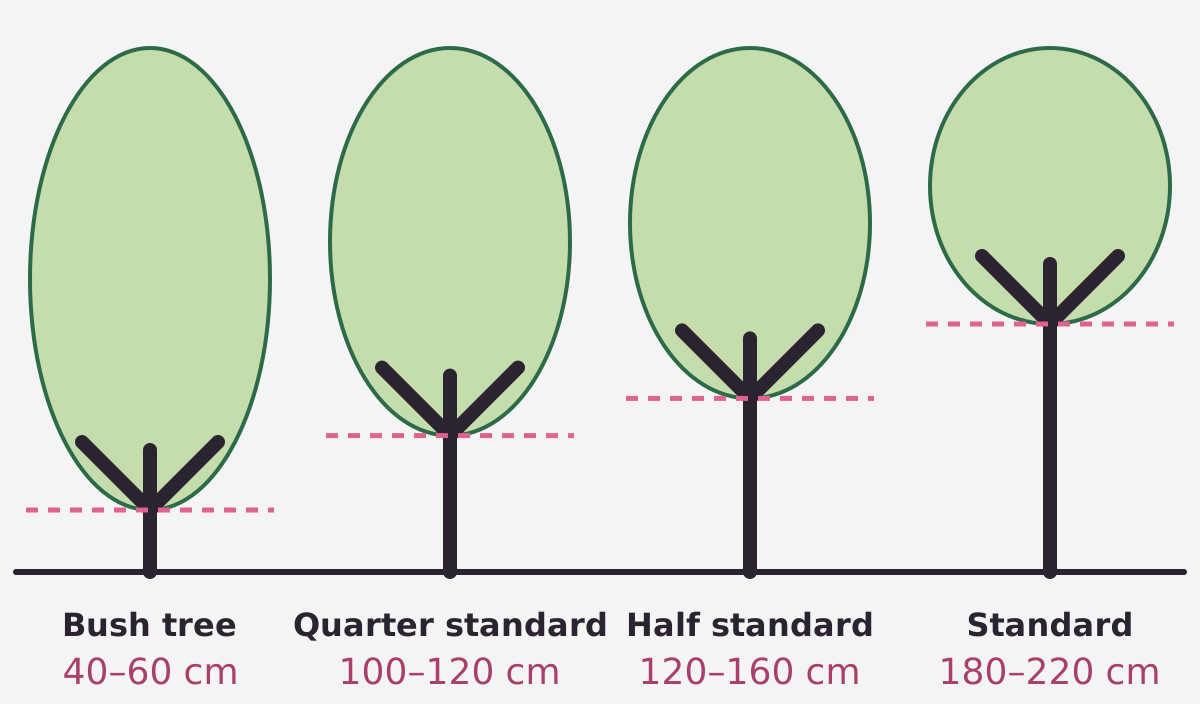
Among other things, the training form indicates the height at which the crown starts, and it doesn’t have that much to do with the tree’s final size.
The crown height is the point where the lowest scaffold (main) branches grow from the trunk. This point stays at the same height for the tree’s whole life. The tree keeps growing, of course, but none of its branch junctions ever moves upwards.
There are a few more training forms, but these four are plenty for our purposes:
| Training form | Crown starts at |
|---|---|
| Dwarf (bush tree) | 40–60 cm |
| Quarter standard | 100–120 cm |
| Half standard | 120–160 cm |
| Standard | 180–220 cm |
On a bush tree, branches this low can start to get in the way over time. For example, when you’re mowing.
Rootstocks
Like training forms, there are lots of rootstocks. They are divided by how they are propagated:
- vegetative – produced, for example, from cuttings or layering. It’s essentially a clone that always has the same properties.
- generative – grown from seed. A lovely example is the Moravian seedling apple (Jadernička moravská), a typical rootstock for apple trees. Every seedling is unique, so their properties differ slightly.
They are also divided by vigour:
- dwarfing – usually vegetative rootstocks,
- semi-vigorous – again mostly vegetative rootstocks,
- vigorous – mostly seedlings, i.e. generative rootstocks.
Every type of rootstock has its pros and cons.
At the nursery, ask mainly about the rootstock. It matters more for the tree’s size than the training form. If you’re not sure which one suits your garden, write to me and I’ll advise you. Get in touch →
Dwarfing rootstock (vegetative)
Pros:
- it starts fruiting early – just 2 years after planting you can be testing the flavour or checking for a little worm,
- you can harvest without a ladder,
- it doesn’t need much space, so it suits even small gardens,
- you get to look after a living, useful and beautiful organism regularly.
Cons (there are more of them, but they’re all outweighed by being able to have a tree at all):
- a small, shallow root system,
- a shorter life, around 20–25 years,
- it needs a support for its whole life, ideally oak or black locust stakes (spruce stakes, even impregnated ones, rot faster),
- higher demands on watering, good soil and possibly feeding. Higher water demands actually mean watering regularly throughout the growing season, not just when it hasn’t rained for 2 months,
- the area around the trunk (a circle of about 1 m) is best kept free of vegetation. Shallow-rooted plants compete with the tree for water and nutrients and can grab a large share of both. The very best thing is to mulch this area (I’ll explain how in another article).
Semi-vigorous rootstock (usually vegetative)
Pros:
- it only needs a support for roughly the first 5 years after planting. That depends on the site, though – on a windy one it’s better to leave the stakes in longer,
- an all-round rootstock for most ordinary gardens,
- thanks to a larger root system it copes better with drought,
- it combines most of the advantages of dwarfing and vigorous rootstocks.
Cons:
- it starts fruiting later than dwarfing rootstocks,
- it needs more space,
- harvesting is less comfortable than with dwarfing rootstocks.
Vigorous rootstock (usually generative)
Pros:
- an extensive root system with plenty of fine roots,
- longevity – with all the best wishes (to the owner), it will probably outlive your children, grandchildren…,
- greater resistance to adverse conditions,
- undemanding – once mature, its deep roots help it cope better with drought or poor soil.
Cons:
- even a vigorous rootstock needs stakes for support for the first 5–6 years,
- the scaffold branches need to be chosen really carefully and the crown well trained, given the long life and the amount of fruit it will carry,
- it needs a lot of space,
- pruning and harvesting will require a ladder and good physical fitness,
- it starts fruiting late.
The rootstock isn’t everything
A tree’s final size and height are affected by many more factors than just the rootstock.
Some fruit tree varieties are genetically more vigorous, others less so. Graft a vigorous variety onto a vigorous rootstock and the resulting tree will be vigorous too.
The final height also depends on water, soil quality (whether there are enough readily available nutrients in the ground), which way the plot faces, the prevailing wind direction, altitude…
Summary
- Branch junctions don’t move upwards as the tree grows; they stay at the same height for the tree’s whole life. The tree just gets sturdier and bushier.
- The training form doesn’t determine the tree’s final size.
- The rootstock is the most important (but not the only) factor in the final height.
- A “dwarf” doesn’t mean the tree will be small, let alone that it will stay the same size.
- A small tree will only grow from a dwarfing rootstock, and only with regular pruning.
And what should you focus on when choosing a tree? How do you find not just the best spot for it, but also the right distance from the fence, the house or other trees? Those are topics for another article.
That’s all, folks.